Number of entries received for the 2008 InnermoonLit Award for Best First Chapter of a Novel to date: 23
An observant contestant pointed out that the Best First Chapter guideline page still listed March 1, 2007 as the deadline. I apologize for failing to catch that when I updated Brian’s site. I am going to use aging as my excuse. Every year, I get a little more absent-minded, and then too, I can’t seem to wrap my brain around the fact that it is 2007, which must have prevented me from realizing that next March will actually be 2008. Where do all the years go?
Back to the writing exercise from earlier this week…besides noticing that you wrote more when you were just observing (and not evaluating as you went along), you might have found that the quality of writing from the second part of the exercise was better.
Therein lies the conundrum of first draft writing. Do you spill it all out fast, NaNoWriMo-style, to prevent paralysis, or do you go at a slow and steady pace, editing yourself as you go along?
Different writers use different strategies when it comes to a first draft. Some prefer a more polished draft and can’t stomach the thought of writing dozens (or even hundreds) of pages that might end up on the cutting room floor, while others don’t mind ruthlessly slashing and burning a messy first draft during revisions.
Play around with both the tortoise and the hare approach. If you’re perpetually frozen with fear of failure (or any other writers' block-creating thoughts), try the speedy, free-writing method. Charge straight ahead without so much as a glance in the rearview mirror.
On the other hand, if you don’t have a problem accumulating pages but have more trouble structuring your writing into a cohesive whole, you might want to invest more time on plotting notes beforehand and on revising as you go along. It will take you longer to reach the end of your first draft, but odds are that when you do, it won’t be quite as much of a baggy monster.
Friday, November 9, 2007

Tuesday, November 6, 2007
November is NaNoWriMo
Number of entries received for the 2008 InnermoonLit Award for Best First Chapter of a Novel to date: 22
There are quite possibly more people writing novels during the month of November than any other time of year, thanks to the popularity of National Novel Writing Month (NaNoWriMo).
In order to ‘win’ NaNoWriMo, participants write a complete novel—defined as 50,000 words—during the month. Here’s a quote from the website: “Valuing enthusiasm and perseverance over painstaking craft, NaNoWriMo is a novel-writing program for everyone who has thought fleetingly about writing a novel but has been scared away by the time and effort involved.”
That kind of free-writing mentality can be useful for cranking out a first draft. Some writers can’t turn off the editors' voices in their heads and end up with writers' block, terrified of making a misstep.
Here’s a writing exercise that quickly illustrates how this approach works. (I didn’t make it up, but alas, I can’t remember where it came from.) Go to a good people-watching spot. First, watch one couple or one small group of people interact. Jot down every single gesture you observe. Do this for 10 minutes.
Next, choose another set of people to watch, but this time, write down only the gestures that you find intriguing. Take 10 minutes again.
You’ll probably find that you wrote a lot more during the first ten minutes than the second. That’s because your inner editor was temporarily silenced. Once you started judging whether your subject matter was good enough to warrant writing about, that slowed you down and decreased your output. More thoughts on this next time...
And hey, if you’re participating in NaNoWriMo this year, remember you have till March 1 to polish up your first chapter and submit it to the InnermoonLit contest.
Thursday, November 1, 2007
Happy Halloweiner
Number of entries received for the 2008 InnermoonLit Award for Best First Chapter of a Novel to date: 21
Hope you had a wonderful Halloween!
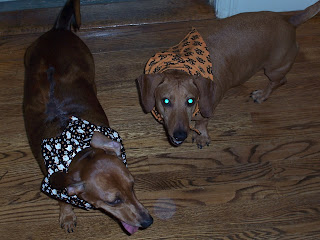
Brodsky's thinking, There are so many little trick-or-treaters out there. Can't I eat just one???
Hope you had a wonderful Halloween!
Brodsky's thinking, There are so many little trick-or-treaters out there. Can't I eat just one???

Monday, October 29, 2007
The reading period continues
Number of entries received for the 2008 InnermoonLit Award for Best First Chapter of a Novel to date: 21
We're knee-deep in Halloween preparations, but we're also slowly making our way through short-short story entries. I like going slowly and not reading more than a few entries a day so that we can give each one extra time and focus. I guess if we ever get deluged, we'll have to speed up our reading, but for now it's nice to take a leisurely pace.
November is just around the corner, though, so final decision time is not that far off. Be sure to keep an eye on your email for the full contest results.
Monday, October 22, 2007
A note about Ellen
Number of entries received for the 2008 InnermoonLit Award for Best First Chapter of a Novel to date: 20
Last Tuesday, Brian and I happened to catch the infamous Ellen episode as it first unfurled. I’m still amazed at this story’s legs and wish there were some way to analyze this viral sensation and harness that power to bring this much public attention to more important issues (or, you know, to Brian’s novels :) ).
The vital ingredients seem to be: a celebrity’s on-air breakdown (which felt very staged, but I can’t decide whether the tinge of falseness contributed to the trainwreck factor or not), a cute puppy, sad children, and two warring factions, both with a sense of righteous anger. It was like the perfect storm of celebrity gossip. Or maybe people are just that bored with the usual celebrity gossip cycle of public intoxication, rehab, couplings, and break-ups.
Anyway, I have to say that Brian and I seem to be in the minority of people who weren’t manipulated into taking Ellen’s side here. The rescue organization’s rules may seem stringent, but these groups create their rules in response to real instances of human neglect and abuse, not because they want to keep dogs away from good homes. Believe it or not, there are malicious and dishonest adopters out there who intend to harm animals, in addition to the more common problem of people with good intentions who, for whatever reason, decide they aren’t willing to commit to an animal and end up abandoning their pets.
The two rescue groups that saved our dogs Kasay and Brodsky had different levels of safeguards and guidelines in place, but they took lots of time to make sure we understood them, as I’m sure Mutts & Moms did with Ellen and Portia. Clearly, these volunteers are motivated by genuine concern for the animals’ well-being, and I think they deserve our admiration. They devote a great deal of time, energy and often their own personal funds to make sure the dogs they rescue stay out of the foster home/dog pound cycle for good.
As Brian used to say when he was teaching, the sad thing about rules is that once you make them, you have to abide by them. There will always be someone who wants to break the rules and face no consequences, but once you make allowances for one person, you have to make allowances for everyone. The issue that seems beyond argument to me is that Ellen knew the rules and chose to enter into a contract with this particular organization. Since this was her second attempt at adopting a dog from this group (she returned a previous dog, also due to cat relation issues), the group was obviously reasonable and willing to give her a second chance.
We admire anyone who volunteers with this type of group and hope this debacle hasn’t sullied the collective reputation of rescue groups.
Wednesday, October 17, 2007
Responding to critique: the emotional part con't.
Number of entries received for the 2008 InnermoonLit Award for Best First Chapter of a Novel to date: 18
OK, I hope you weren’t waiting with bated breath or anything, because I don’t really have any gimmicky trick that will help you accept criticism gracefully other than this piece of common sense advice: let some time pass.
Time is the best way to silence the defensive voice in your head. If you’re getting oral feedback from your reader, don’t interrupt. Let your reader talk, and take copious notes. Set the notes aside for awhile till the negative comments lose their sting and you can really digest them.
Time is the key to being able to evaluate your writing objectively. More experienced writers tend to have more callouses built up than beginners. That’s part of what I mean. But each new piece of writing needs a little time to breathe too. When the ink on the page is still wet and you’re feeling euphoric about what you’ve just written down, that’s not the time to call in your reader for a critique. Wait a day or a week or a month—however long it takes for you to achieve that slightly detached, cold-light-of-dawn perspective.
Time also gives you a chance to do some solo revising. Rough drafts are meant to be rough. You aren’t worried about perfection; you just want to get the words flowing. And that’s the way it should be. Your work has its own life cycle, and before you show your newborn to even one other person, you might want to clean it up a little and throw a diaper on it.
In her book The Creative Habit, Twyla Tharp talks about failure as an integral part of any creative endeavor. She distinguishes between private and public failures, saying the more you fail in private, the less likely you’ll be to fail in public (which of course is much more painful and embarrassing). The more you edit your work alone, the fewer mistakes your reader will find. In turn, the more help you can get from a reader before sending your work to an even greater public, the greater your chances for success.
Monday, October 15, 2007
Responding to a critique: the emotional part
Number of entries received for the 2008 InnermoonLit Award for Best First Chapter of a Novel to date: 18
When someone tells you something you don’t want to hear, it’s natural to respond with defensiveness. If you get some less-than-glowing feedback as part of a critique (and believe me, I know how much even the mildest criticism can sting), you may be tempted to either argue back or take the passive approach—pretend to agree, then proceed to ignore and dismiss the suggestions.
That response isn’t helpful to anyone, and it’s an urge all writers must fight. Not only is your piece of writing not going to improve in a vacuum, but if you blow up at your reader, you could end up with hurt feelings on both sides and a permanently damaged relationship.
You should trust your reader’s judgment and taste and be certain that he wants to help you improve and is not just saying mean things for the fun of it, and if you don't...well, you need to find a different reader. On the other hand, if you did trust his skill, integrity, and motivation to start with, you have to believe that whatever criticisms he’s offering are given for the sake of improving your writing, not to make you feel bad.
Next time I'll have some advice on how to combat this defensive reflex so that you can get as much good as possible out of a critique.
Subscribe to:
Posts (Atom)