Number of entries received for the 2008 InnermoonLit Award for Best Short-Short Story: 90
Only a few more hours to get your teeny tiny stories submitted. When September 1 ends on the East Coast, so does your chance to enter the 2008 Short-Short Story contest, so no more procrastinating!
Monday, September 1, 2008

Thursday, June 19, 2008
Weapon of Choice
Number of entries received for the 2008 InnermoonLit Award for Best Short-Short Story: 30
I have an abnormal fondness for pens. I'm not sure exactly when this passion was born, but by the time I was in high school, my tastes had become so specialized that I was almost exclusively using fountain pens (no wonder I disliked math class--the one place I couldn't get inky). My best friend shared my obsession, and we traded different colored ink cartridges back and forth the way some teenaged girls swap lipsticks.
My friend and I were a minority of two in this regard. I'll admit to getting a twisted thrill out of brandishing my blackened hands at cheerleaders, pretending I was going to rub ink on them. It never failed to draw a most comical look of utter terror.
Little did I know that, across the state, my future husband was toiling away with ink-stained fingertips, changing out empty cartridges at inopportune moments, washing dried-out and clogged nubs, making a joyful mess with a fistful of his own Schaeffers.
Sadly, Brian's and my combined efforts apparently weren't enough to keep the mass production of fountain pens a lucrative venture. The only fountain pens at Office Depot these days are the boxed-gift variety, costing $25 and up, with special, impossible-to-find refills. And they don't even work as well as the three buck Schaeffers did.
You can imagine my excitement when I discovered the Varsity disposable fountain pen. Yes, the disposability pretty much negates the purpose of a fountain pen, but I'll admit I'm hooked. It has that good old fountain pen feel. The ink looks rich on the page, and the angled nub makes the worst chicken scratch look more elegant. Because they're disposable, they're mess-free too, which I appreciate now that I'm an adult and need to at least try to blend into the mainstream.
So please, do me a favor and order some to keep them from going extinct. They have black, blue, purple, and even turquoise ink. I see that Foray now has an even cheaper disposable fountain pen, (which hopefully means Pilot's pen has been a smashing success) but I haven't tried these yet and can't vouch for them.
I have an abnormal fondness for pens. I'm not sure exactly when this passion was born, but by the time I was in high school, my tastes had become so specialized that I was almost exclusively using fountain pens (no wonder I disliked math class--the one place I couldn't get inky). My best friend shared my obsession, and we traded different colored ink cartridges back and forth the way some teenaged girls swap lipsticks.
My friend and I were a minority of two in this regard. I'll admit to getting a twisted thrill out of brandishing my blackened hands at cheerleaders, pretending I was going to rub ink on them. It never failed to draw a most comical look of utter terror.
Little did I know that, across the state, my future husband was toiling away with ink-stained fingertips, changing out empty cartridges at inopportune moments, washing dried-out and clogged nubs, making a joyful mess with a fistful of his own Schaeffers.
Sadly, Brian's and my combined efforts apparently weren't enough to keep the mass production of fountain pens a lucrative venture. The only fountain pens at Office Depot these days are the boxed-gift variety, costing $25 and up, with special, impossible-to-find refills. And they don't even work as well as the three buck Schaeffers did.
You can imagine my excitement when I discovered the Varsity disposable fountain pen. Yes, the disposability pretty much negates the purpose of a fountain pen, but I'll admit I'm hooked. It has that good old fountain pen feel. The ink looks rich on the page, and the angled nub makes the worst chicken scratch look more elegant. Because they're disposable, they're mess-free too, which I appreciate now that I'm an adult and need to at least try to blend into the mainstream.
So please, do me a favor and order some to keep them from going extinct. They have black, blue, purple, and even turquoise ink. I see that Foray now has an even cheaper disposable fountain pen, (which hopefully means Pilot's pen has been a smashing success) but I haven't tried these yet and can't vouch for them.
Monday, June 9, 2008
Results have been posted!
Total number of entries received for the 2008 InnermoonLit Award for Best First Chapter of a Novel: 198
Number of entries received for the 2008 InnermoonLit Award for Best Short-Short Story: 23
We emailed our mysterious winners and have heard back from all three. Their bios--impressive as always--and have now been posted. The Best First Chapter contest always leaves us feeling a bit unsettled. We want to read chapters two and three and four and so on till we reach THE END. Hopefully these talented writers' novels will be available at a bookstore near you soon, and we'll all be able to keep turning the pages and find out what happens next.
Congratulations to our winners! We'll be putting the money orders in the mail today (apologies to our two international writers for the current weak state of the dollar). Thanks to everyone who took the time to find us and to submit your work. As you can see, your chances for the short-short story contest are quite good at the moment, so if you have a short piece of fiction, send it our way.
Number of entries received for the 2008 InnermoonLit Award for Best Short-Short Story: 23
We emailed our mysterious winners and have heard back from all three. Their bios--impressive as always--and have now been posted. The Best First Chapter contest always leaves us feeling a bit unsettled. We want to read chapters two and three and four and so on till we reach THE END. Hopefully these talented writers' novels will be available at a bookstore near you soon, and we'll all be able to keep turning the pages and find out what happens next.
Congratulations to our winners! We'll be putting the money orders in the mail today (apologies to our two international writers for the current weak state of the dollar). Thanks to everyone who took the time to find us and to submit your work. As you can see, your chances for the short-short story contest are quite good at the moment, so if you have a short piece of fiction, send it our way.
Tuesday, February 19, 2008
Deadline looming
Number of entries received for the 2008 InnermoonLit Award for Best First Chapter of a Novel to date: 140
If anyone’s still checking in, I apologize for the prolonged absence. Life has just been a little too interesting the last couple of months.
Contest entries started pouring in last week, and my first thought was that the new online Writers’ Market listing must’ve gone up. It finally occurred to me that it’s end-of-the wire time, which is always extra busy. I can’t believe we’ve almost reached another deadline. Leap year gives you an extra day, so be sure to get your first chapter in before March 1.
If anyone’s still checking in, I apologize for the prolonged absence. Life has just been a little too interesting the last couple of months.
Contest entries started pouring in last week, and my first thought was that the new online Writers’ Market listing must’ve gone up. It finally occurred to me that it’s end-of-the wire time, which is always extra busy. I can’t believe we’ve almost reached another deadline. Leap year gives you an extra day, so be sure to get your first chapter in before March 1.
Wednesday, December 12, 2007
Contest prize change
Number of entries received for the 2008 InnermoonLit Award for Best First Chapter of a Novel to date: 42
I went to the post office during my lunch hour yesterday to buy money orders, but when I saw the line stretching outside the door, I did a 180. All those people with Christmas packages reminded me I have three I need to get in the mail myself, so I figured if I have to stand in line, it makes more sense to just do it all at once. Course that means I have to actually get the gifts I've bought boxed up. I don't know why that small step seems to take so long.
But I promise, contest winners, the prizes will go out in the mail this week.
Which reminds me of some fun news--one of Brian's goals is to increase the prize amounts, and he decided at the last minute to take a small step in that direction now. Effective immediately, third place will get $25 in addition to an autographed novel.
It'll probably be a year or two till we bump up all the prize amounts, but that is part of the grand scheme. Don't worry though--the contests will always be free to enter.
I went to the post office during my lunch hour yesterday to buy money orders, but when I saw the line stretching outside the door, I did a 180. All those people with Christmas packages reminded me I have three I need to get in the mail myself, so I figured if I have to stand in line, it makes more sense to just do it all at once. Course that means I have to actually get the gifts I've bought boxed up. I don't know why that small step seems to take so long.
But I promise, contest winners, the prizes will go out in the mail this week.
Which reminds me of some fun news--one of Brian's goals is to increase the prize amounts, and he decided at the last minute to take a small step in that direction now. Effective immediately, third place will get $25 in addition to an autographed novel.
It'll probably be a year or two till we bump up all the prize amounts, but that is part of the grand scheme. Don't worry though--the contests will always be free to enter.
Monday, December 10, 2007
Post-contest letdown
Number of entries received for the 2008 InnermoonLit Award for Best First Chapter of a Novel to date: 37
Usually prize-awarding time puts me in a good mood, but after these recent comments, I'm feeling guilty. We certainly never meant to discourage or sadden anyone with these contests.
If you entered but didn't win, take heart. Think of all the people who say they want to write but never do. You overcame that hurdle. Then you showed courage in sending out your work. I know that isn't easy.
My dad, a seasoned freelance illustrator, came to talk to my freshmen about the creative process a couple weeks ago, and he reminded them (and me) this: every artist out there with an impressive list of achievements has a much longer (usually secret) list of rejections and disappointments. There will be stretches of time when you aren't rewarded for your efforts, so you have to be patient and persistent.
I'm not trying to discourage you further; I'm just trying to say that everyone who sets out to be any kind of artist has obstacles constantly springing up in front of them. Most eventually give up, but some keep stubbornly finding ways over and around those obstacles.
There's so much of this business you can't control--whether it's winning a contest, getting a work accepted for publication, or landing a grant. The only thing you can truly control is yourself and your work. If you refuse to give up, if you commit yourself to honing your craft and doing your best work, if you continue to send out your work, then you are a writer, and no one can tell you otherwise. The external validations are bound to follow.
Usually prize-awarding time puts me in a good mood, but after these recent comments, I'm feeling guilty. We certainly never meant to discourage or sadden anyone with these contests.
If you entered but didn't win, take heart. Think of all the people who say they want to write but never do. You overcame that hurdle. Then you showed courage in sending out your work. I know that isn't easy.
My dad, a seasoned freelance illustrator, came to talk to my freshmen about the creative process a couple weeks ago, and he reminded them (and me) this: every artist out there with an impressive list of achievements has a much longer (usually secret) list of rejections and disappointments. There will be stretches of time when you aren't rewarded for your efforts, so you have to be patient and persistent.
I'm not trying to discourage you further; I'm just trying to say that everyone who sets out to be any kind of artist has obstacles constantly springing up in front of them. Most eventually give up, but some keep stubbornly finding ways over and around those obstacles.
There's so much of this business you can't control--whether it's winning a contest, getting a work accepted for publication, or landing a grant. The only thing you can truly control is yourself and your work. If you refuse to give up, if you commit yourself to honing your craft and doing your best work, if you continue to send out your work, then you are a writer, and no one can tell you otherwise. The external validations are bound to follow.
Monday, December 3, 2007
Quick contest update
Number of entries received for the 2008 InnermoonLit Award for Best First Chapter of a Novel to date: 35
Time flies fast during the holidays. Then too, we've been having some computer problems which have put me more in a pen-and-paper mode of experiencing time. From an electronic perspective, I haven't posted in ages, though it really doesn't feel that long to me.
Contest judging for the short-short story contest has been completed! I know we're running late with the official announcement, but we haven't heard back from all three winners yet. So remember to check all your email accounts if you entered. Hopefully the news will get posted soon.
Time flies fast during the holidays. Then too, we've been having some computer problems which have put me more in a pen-and-paper mode of experiencing time. From an electronic perspective, I haven't posted in ages, though it really doesn't feel that long to me.
Contest judging for the short-short story contest has been completed! I know we're running late with the official announcement, but we haven't heard back from all three winners yet. So remember to check all your email accounts if you entered. Hopefully the news will get posted soon.
Friday, November 9, 2007
The tortoise and the hare
Number of entries received for the 2008 InnermoonLit Award for Best First Chapter of a Novel to date: 23
An observant contestant pointed out that the Best First Chapter guideline page still listed March 1, 2007 as the deadline. I apologize for failing to catch that when I updated Brian’s site. I am going to use aging as my excuse. Every year, I get a little more absent-minded, and then too, I can’t seem to wrap my brain around the fact that it is 2007, which must have prevented me from realizing that next March will actually be 2008. Where do all the years go?
Back to the writing exercise from earlier this week…besides noticing that you wrote more when you were just observing (and not evaluating as you went along), you might have found that the quality of writing from the second part of the exercise was better.
Therein lies the conundrum of first draft writing. Do you spill it all out fast, NaNoWriMo-style, to prevent paralysis, or do you go at a slow and steady pace, editing yourself as you go along?
Different writers use different strategies when it comes to a first draft. Some prefer a more polished draft and can’t stomach the thought of writing dozens (or even hundreds) of pages that might end up on the cutting room floor, while others don’t mind ruthlessly slashing and burning a messy first draft during revisions.
Play around with both the tortoise and the hare approach. If you’re perpetually frozen with fear of failure (or any other writers' block-creating thoughts), try the speedy, free-writing method. Charge straight ahead without so much as a glance in the rearview mirror.
On the other hand, if you don’t have a problem accumulating pages but have more trouble structuring your writing into a cohesive whole, you might want to invest more time on plotting notes beforehand and on revising as you go along. It will take you longer to reach the end of your first draft, but odds are that when you do, it won’t be quite as much of a baggy monster.
An observant contestant pointed out that the Best First Chapter guideline page still listed March 1, 2007 as the deadline. I apologize for failing to catch that when I updated Brian’s site. I am going to use aging as my excuse. Every year, I get a little more absent-minded, and then too, I can’t seem to wrap my brain around the fact that it is 2007, which must have prevented me from realizing that next March will actually be 2008. Where do all the years go?
Back to the writing exercise from earlier this week…besides noticing that you wrote more when you were just observing (and not evaluating as you went along), you might have found that the quality of writing from the second part of the exercise was better.
Therein lies the conundrum of first draft writing. Do you spill it all out fast, NaNoWriMo-style, to prevent paralysis, or do you go at a slow and steady pace, editing yourself as you go along?
Different writers use different strategies when it comes to a first draft. Some prefer a more polished draft and can’t stomach the thought of writing dozens (or even hundreds) of pages that might end up on the cutting room floor, while others don’t mind ruthlessly slashing and burning a messy first draft during revisions.
Play around with both the tortoise and the hare approach. If you’re perpetually frozen with fear of failure (or any other writers' block-creating thoughts), try the speedy, free-writing method. Charge straight ahead without so much as a glance in the rearview mirror.
On the other hand, if you don’t have a problem accumulating pages but have more trouble structuring your writing into a cohesive whole, you might want to invest more time on plotting notes beforehand and on revising as you go along. It will take you longer to reach the end of your first draft, but odds are that when you do, it won’t be quite as much of a baggy monster.
Tuesday, November 6, 2007
November is NaNoWriMo
Number of entries received for the 2008 InnermoonLit Award for Best First Chapter of a Novel to date: 22
There are quite possibly more people writing novels during the month of November than any other time of year, thanks to the popularity of National Novel Writing Month (NaNoWriMo).
In order to ‘win’ NaNoWriMo, participants write a complete novel—defined as 50,000 words—during the month. Here’s a quote from the website: “Valuing enthusiasm and perseverance over painstaking craft, NaNoWriMo is a novel-writing program for everyone who has thought fleetingly about writing a novel but has been scared away by the time and effort involved.”
That kind of free-writing mentality can be useful for cranking out a first draft. Some writers can’t turn off the editors' voices in their heads and end up with writers' block, terrified of making a misstep.
Here’s a writing exercise that quickly illustrates how this approach works. (I didn’t make it up, but alas, I can’t remember where it came from.) Go to a good people-watching spot. First, watch one couple or one small group of people interact. Jot down every single gesture you observe. Do this for 10 minutes.
Next, choose another set of people to watch, but this time, write down only the gestures that you find intriguing. Take 10 minutes again.
You’ll probably find that you wrote a lot more during the first ten minutes than the second. That’s because your inner editor was temporarily silenced. Once you started judging whether your subject matter was good enough to warrant writing about, that slowed you down and decreased your output. More thoughts on this next time...
And hey, if you’re participating in NaNoWriMo this year, remember you have till March 1 to polish up your first chapter and submit it to the InnermoonLit contest.
There are quite possibly more people writing novels during the month of November than any other time of year, thanks to the popularity of National Novel Writing Month (NaNoWriMo).
In order to ‘win’ NaNoWriMo, participants write a complete novel—defined as 50,000 words—during the month. Here’s a quote from the website: “Valuing enthusiasm and perseverance over painstaking craft, NaNoWriMo is a novel-writing program for everyone who has thought fleetingly about writing a novel but has been scared away by the time and effort involved.”
That kind of free-writing mentality can be useful for cranking out a first draft. Some writers can’t turn off the editors' voices in their heads and end up with writers' block, terrified of making a misstep.
Here’s a writing exercise that quickly illustrates how this approach works. (I didn’t make it up, but alas, I can’t remember where it came from.) Go to a good people-watching spot. First, watch one couple or one small group of people interact. Jot down every single gesture you observe. Do this for 10 minutes.
Next, choose another set of people to watch, but this time, write down only the gestures that you find intriguing. Take 10 minutes again.
You’ll probably find that you wrote a lot more during the first ten minutes than the second. That’s because your inner editor was temporarily silenced. Once you started judging whether your subject matter was good enough to warrant writing about, that slowed you down and decreased your output. More thoughts on this next time...
And hey, if you’re participating in NaNoWriMo this year, remember you have till March 1 to polish up your first chapter and submit it to the InnermoonLit contest.
Thursday, November 1, 2007
Happy Halloweiner
Number of entries received for the 2008 InnermoonLit Award for Best First Chapter of a Novel to date: 21
Hope you had a wonderful Halloween!
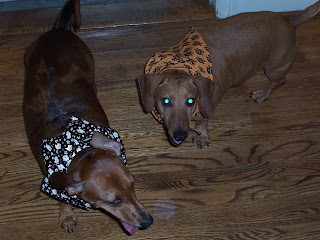
Brodsky's thinking, There are so many little trick-or-treaters out there. Can't I eat just one???
Hope you had a wonderful Halloween!
Brodsky's thinking, There are so many little trick-or-treaters out there. Can't I eat just one???

Monday, October 29, 2007
The reading period continues
Number of entries received for the 2008 InnermoonLit Award for Best First Chapter of a Novel to date: 21
We're knee-deep in Halloween preparations, but we're also slowly making our way through short-short story entries. I like going slowly and not reading more than a few entries a day so that we can give each one extra time and focus. I guess if we ever get deluged, we'll have to speed up our reading, but for now it's nice to take a leisurely pace.
November is just around the corner, though, so final decision time is not that far off. Be sure to keep an eye on your email for the full contest results.
We're knee-deep in Halloween preparations, but we're also slowly making our way through short-short story entries. I like going slowly and not reading more than a few entries a day so that we can give each one extra time and focus. I guess if we ever get deluged, we'll have to speed up our reading, but for now it's nice to take a leisurely pace.
November is just around the corner, though, so final decision time is not that far off. Be sure to keep an eye on your email for the full contest results.
Monday, October 22, 2007
A note about Ellen
Number of entries received for the 2008 InnermoonLit Award for Best First Chapter of a Novel to date: 20
Last Tuesday, Brian and I happened to catch the infamous Ellen episode as it first unfurled. I’m still amazed at this story’s legs and wish there were some way to analyze this viral sensation and harness that power to bring this much public attention to more important issues (or, you know, to Brian’s novels :) ).
The vital ingredients seem to be: a celebrity’s on-air breakdown (which felt very staged, but I can’t decide whether the tinge of falseness contributed to the trainwreck factor or not), a cute puppy, sad children, and two warring factions, both with a sense of righteous anger. It was like the perfect storm of celebrity gossip. Or maybe people are just that bored with the usual celebrity gossip cycle of public intoxication, rehab, couplings, and break-ups.
Anyway, I have to say that Brian and I seem to be in the minority of people who weren’t manipulated into taking Ellen’s side here. The rescue organization’s rules may seem stringent, but these groups create their rules in response to real instances of human neglect and abuse, not because they want to keep dogs away from good homes. Believe it or not, there are malicious and dishonest adopters out there who intend to harm animals, in addition to the more common problem of people with good intentions who, for whatever reason, decide they aren’t willing to commit to an animal and end up abandoning their pets.
The two rescue groups that saved our dogs Kasay and Brodsky had different levels of safeguards and guidelines in place, but they took lots of time to make sure we understood them, as I’m sure Mutts & Moms did with Ellen and Portia. Clearly, these volunteers are motivated by genuine concern for the animals’ well-being, and I think they deserve our admiration. They devote a great deal of time, energy and often their own personal funds to make sure the dogs they rescue stay out of the foster home/dog pound cycle for good.
As Brian used to say when he was teaching, the sad thing about rules is that once you make them, you have to abide by them. There will always be someone who wants to break the rules and face no consequences, but once you make allowances for one person, you have to make allowances for everyone. The issue that seems beyond argument to me is that Ellen knew the rules and chose to enter into a contract with this particular organization. Since this was her second attempt at adopting a dog from this group (she returned a previous dog, also due to cat relation issues), the group was obviously reasonable and willing to give her a second chance.
We admire anyone who volunteers with this type of group and hope this debacle hasn’t sullied the collective reputation of rescue groups.
Last Tuesday, Brian and I happened to catch the infamous Ellen episode as it first unfurled. I’m still amazed at this story’s legs and wish there were some way to analyze this viral sensation and harness that power to bring this much public attention to more important issues (or, you know, to Brian’s novels :) ).
The vital ingredients seem to be: a celebrity’s on-air breakdown (which felt very staged, but I can’t decide whether the tinge of falseness contributed to the trainwreck factor or not), a cute puppy, sad children, and two warring factions, both with a sense of righteous anger. It was like the perfect storm of celebrity gossip. Or maybe people are just that bored with the usual celebrity gossip cycle of public intoxication, rehab, couplings, and break-ups.
Anyway, I have to say that Brian and I seem to be in the minority of people who weren’t manipulated into taking Ellen’s side here. The rescue organization’s rules may seem stringent, but these groups create their rules in response to real instances of human neglect and abuse, not because they want to keep dogs away from good homes. Believe it or not, there are malicious and dishonest adopters out there who intend to harm animals, in addition to the more common problem of people with good intentions who, for whatever reason, decide they aren’t willing to commit to an animal and end up abandoning their pets.
The two rescue groups that saved our dogs Kasay and Brodsky had different levels of safeguards and guidelines in place, but they took lots of time to make sure we understood them, as I’m sure Mutts & Moms did with Ellen and Portia. Clearly, these volunteers are motivated by genuine concern for the animals’ well-being, and I think they deserve our admiration. They devote a great deal of time, energy and often their own personal funds to make sure the dogs they rescue stay out of the foster home/dog pound cycle for good.
As Brian used to say when he was teaching, the sad thing about rules is that once you make them, you have to abide by them. There will always be someone who wants to break the rules and face no consequences, but once you make allowances for one person, you have to make allowances for everyone. The issue that seems beyond argument to me is that Ellen knew the rules and chose to enter into a contract with this particular organization. Since this was her second attempt at adopting a dog from this group (she returned a previous dog, also due to cat relation issues), the group was obviously reasonable and willing to give her a second chance.
We admire anyone who volunteers with this type of group and hope this debacle hasn’t sullied the collective reputation of rescue groups.
Wednesday, October 17, 2007
Responding to critique: the emotional part con't.
Number of entries received for the 2008 InnermoonLit Award for Best First Chapter of a Novel to date: 18
OK, I hope you weren’t waiting with bated breath or anything, because I don’t really have any gimmicky trick that will help you accept criticism gracefully other than this piece of common sense advice: let some time pass.
Time is the best way to silence the defensive voice in your head. If you’re getting oral feedback from your reader, don’t interrupt. Let your reader talk, and take copious notes. Set the notes aside for awhile till the negative comments lose their sting and you can really digest them.
Time is the key to being able to evaluate your writing objectively. More experienced writers tend to have more callouses built up than beginners. That’s part of what I mean. But each new piece of writing needs a little time to breathe too. When the ink on the page is still wet and you’re feeling euphoric about what you’ve just written down, that’s not the time to call in your reader for a critique. Wait a day or a week or a month—however long it takes for you to achieve that slightly detached, cold-light-of-dawn perspective.
Time also gives you a chance to do some solo revising. Rough drafts are meant to be rough. You aren’t worried about perfection; you just want to get the words flowing. And that’s the way it should be. Your work has its own life cycle, and before you show your newborn to even one other person, you might want to clean it up a little and throw a diaper on it.
In her book The Creative Habit, Twyla Tharp talks about failure as an integral part of any creative endeavor. She distinguishes between private and public failures, saying the more you fail in private, the less likely you’ll be to fail in public (which of course is much more painful and embarrassing). The more you edit your work alone, the fewer mistakes your reader will find. In turn, the more help you can get from a reader before sending your work to an even greater public, the greater your chances for success.
OK, I hope you weren’t waiting with bated breath or anything, because I don’t really have any gimmicky trick that will help you accept criticism gracefully other than this piece of common sense advice: let some time pass.
Time is the best way to silence the defensive voice in your head. If you’re getting oral feedback from your reader, don’t interrupt. Let your reader talk, and take copious notes. Set the notes aside for awhile till the negative comments lose their sting and you can really digest them.
Time is the key to being able to evaluate your writing objectively. More experienced writers tend to have more callouses built up than beginners. That’s part of what I mean. But each new piece of writing needs a little time to breathe too. When the ink on the page is still wet and you’re feeling euphoric about what you’ve just written down, that’s not the time to call in your reader for a critique. Wait a day or a week or a month—however long it takes for you to achieve that slightly detached, cold-light-of-dawn perspective.
Time also gives you a chance to do some solo revising. Rough drafts are meant to be rough. You aren’t worried about perfection; you just want to get the words flowing. And that’s the way it should be. Your work has its own life cycle, and before you show your newborn to even one other person, you might want to clean it up a little and throw a diaper on it.
In her book The Creative Habit, Twyla Tharp talks about failure as an integral part of any creative endeavor. She distinguishes between private and public failures, saying the more you fail in private, the less likely you’ll be to fail in public (which of course is much more painful and embarrassing). The more you edit your work alone, the fewer mistakes your reader will find. In turn, the more help you can get from a reader before sending your work to an even greater public, the greater your chances for success.
Monday, October 15, 2007
Responding to a critique: the emotional part
Number of entries received for the 2008 InnermoonLit Award for Best First Chapter of a Novel to date: 18
When someone tells you something you don’t want to hear, it’s natural to respond with defensiveness. If you get some less-than-glowing feedback as part of a critique (and believe me, I know how much even the mildest criticism can sting), you may be tempted to either argue back or take the passive approach—pretend to agree, then proceed to ignore and dismiss the suggestions.
That response isn’t helpful to anyone, and it’s an urge all writers must fight. Not only is your piece of writing not going to improve in a vacuum, but if you blow up at your reader, you could end up with hurt feelings on both sides and a permanently damaged relationship.
You should trust your reader’s judgment and taste and be certain that he wants to help you improve and is not just saying mean things for the fun of it, and if you don't...well, you need to find a different reader. On the other hand, if you did trust his skill, integrity, and motivation to start with, you have to believe that whatever criticisms he’s offering are given for the sake of improving your writing, not to make you feel bad.
Next time I'll have some advice on how to combat this defensive reflex so that you can get as much good as possible out of a critique.
When someone tells you something you don’t want to hear, it’s natural to respond with defensiveness. If you get some less-than-glowing feedback as part of a critique (and believe me, I know how much even the mildest criticism can sting), you may be tempted to either argue back or take the passive approach—pretend to agree, then proceed to ignore and dismiss the suggestions.
That response isn’t helpful to anyone, and it’s an urge all writers must fight. Not only is your piece of writing not going to improve in a vacuum, but if you blow up at your reader, you could end up with hurt feelings on both sides and a permanently damaged relationship.
You should trust your reader’s judgment and taste and be certain that he wants to help you improve and is not just saying mean things for the fun of it, and if you don't...well, you need to find a different reader. On the other hand, if you did trust his skill, integrity, and motivation to start with, you have to believe that whatever criticisms he’s offering are given for the sake of improving your writing, not to make you feel bad.
Next time I'll have some advice on how to combat this defensive reflex so that you can get as much good as possible out of a critique.
Wednesday, October 10, 2007
Putting theory into practice
Number of entries received for the 2008 InnermoonLit Award for Best First Chapter of a Novel to date: 18
Let’s say you have a skilled and trusted reader or two to help you edit your work. Now comes the hard part: taking their advice. It’s hard to edit someone else’s writing—to figure out where its weaknesses lie and suggest fixes. But when you are the writer getting critiqued, implementing that advice is even more difficult, on both emotional and intellectual levels.
Brian and I are currently in the middle of an editing project for a writer who is refreshingly open to suggestions and quite adept at revising, which I guess is what brought this issue to mind. If you’ve ever taught English or writing or participated in any kind of workshop or critique group, you know how rare it is to find writers, like the one we’re fortunate to be working with now, who are able to use constructive criticism to really improve their work.
Let’s talk about the simple, intellectual side of this issue first and leave the sticky emotional part till later. There’s no doubt about it: big-picture fixes are hard to implement. Completely changing a character’s motivation or reordering a series of events in your story or correcting a logistical error with a plotline are all far easier said than done. Your ‘fix’ may end up being less effective than the original version or may cause unforeseen problems with the story later on, making your whole house of cards collapse.
Brian has a good trick to circumvent that problem: whenever he’s planning a big revision, he also keeps the older version of the file intact in case he decides to reverse the changes later on. Thanks to the computer, this is pretty easy to do. Now I don’t suggest making a different version of your file every single time you revise, only when you’re undertaking major surgery. Keeping more than two or three versions of a file can get too confusing.
Once your big-picture problems are out of the way, though, even the small-scale fixes can be tricky to make. Just entering line edits can be tedious and creates opportunities for even more typos to sneak their way into your work.
Revising your work will probably take even more time and energy than writing the first draft did, so be prepared to give it all the care and patience it needs during the polishing phase.
Let’s say you have a skilled and trusted reader or two to help you edit your work. Now comes the hard part: taking their advice. It’s hard to edit someone else’s writing—to figure out where its weaknesses lie and suggest fixes. But when you are the writer getting critiqued, implementing that advice is even more difficult, on both emotional and intellectual levels.
Brian and I are currently in the middle of an editing project for a writer who is refreshingly open to suggestions and quite adept at revising, which I guess is what brought this issue to mind. If you’ve ever taught English or writing or participated in any kind of workshop or critique group, you know how rare it is to find writers, like the one we’re fortunate to be working with now, who are able to use constructive criticism to really improve their work.
Let’s talk about the simple, intellectual side of this issue first and leave the sticky emotional part till later. There’s no doubt about it: big-picture fixes are hard to implement. Completely changing a character’s motivation or reordering a series of events in your story or correcting a logistical error with a plotline are all far easier said than done. Your ‘fix’ may end up being less effective than the original version or may cause unforeseen problems with the story later on, making your whole house of cards collapse.
Brian has a good trick to circumvent that problem: whenever he’s planning a big revision, he also keeps the older version of the file intact in case he decides to reverse the changes later on. Thanks to the computer, this is pretty easy to do. Now I don’t suggest making a different version of your file every single time you revise, only when you’re undertaking major surgery. Keeping more than two or three versions of a file can get too confusing.
Once your big-picture problems are out of the way, though, even the small-scale fixes can be tricky to make. Just entering line edits can be tedious and creates opportunities for even more typos to sneak their way into your work.
Revising your work will probably take even more time and energy than writing the first draft did, so be prepared to give it all the care and patience it needs during the polishing phase.
Monday, October 8, 2007
The forest and the trees
Number of entries received for the 2008 InnermoonLit Award for Best First Chapter of a Novel to date: 18
Last week, I said writers might find it helpful to have separate readers for higher-order and lower-order concerns. Brian and I have worked a handful of times on editing jobs for other writers, and that’s exactly how we operate.
Brian is excellent at the higher-order stuff: honing in on issues of pacing, structure, dialogue, characterization, and so forth. He’s also great at suggesting ways to fix big-picture level problems. I can often sense when something’s amiss on this level but am not good at knowing exactly how to fix it.
On the other hand, I have become a pretty good line editor over the years. I try to pay attention to tiny details, like noticing if a character’s eyes are brown on page 10 and blue on page 200, or keeping up with how much story time elapses between plot points, what season it’s supposed to be, and so on. Comma and spelling errors tend to jump out at me now as if lighted by neon.
With me holding my magnifying lens up to the tree bark, Brian is free to concentrate on the forest--although truth be told, he also picks up a lot of grammar errors. We tend to edit on our own, then consolidate all the marks onto one copy, and I always feel validated when we both mark the same errors.
Of course, when it comes to higher- and lower-order concerns, sequence is important. You really don’t need to be worrying too much about minutiae until your later revisions. There’s no point agonizing over every punctuation mark when entire chapters may need to be cut or completely rewritten in order to fix a higher-order concern. Always revise with an eye toward the big picture first.
Last week, I said writers might find it helpful to have separate readers for higher-order and lower-order concerns. Brian and I have worked a handful of times on editing jobs for other writers, and that’s exactly how we operate.
Brian is excellent at the higher-order stuff: honing in on issues of pacing, structure, dialogue, characterization, and so forth. He’s also great at suggesting ways to fix big-picture level problems. I can often sense when something’s amiss on this level but am not good at knowing exactly how to fix it.
On the other hand, I have become a pretty good line editor over the years. I try to pay attention to tiny details, like noticing if a character’s eyes are brown on page 10 and blue on page 200, or keeping up with how much story time elapses between plot points, what season it’s supposed to be, and so on. Comma and spelling errors tend to jump out at me now as if lighted by neon.
With me holding my magnifying lens up to the tree bark, Brian is free to concentrate on the forest--although truth be told, he also picks up a lot of grammar errors. We tend to edit on our own, then consolidate all the marks onto one copy, and I always feel validated when we both mark the same errors.
Of course, when it comes to higher- and lower-order concerns, sequence is important. You really don’t need to be worrying too much about minutiae until your later revisions. There’s no point agonizing over every punctuation mark when entire chapters may need to be cut or completely rewritten in order to fix a higher-order concern. Always revise with an eye toward the big picture first.
Friday, October 5, 2007
Brodsky the Wonder Dog
Number of entries received for the 2008 InnermoonLit Award for Best First Chapter of a Novel to date: 17
When you have multiple dogs, one thing you quickly learn about is sibling rivalry. When Brodsky gives us a disdainful look if he thinks Kasay’s gotten a bigger treat (and vice versa), it takes me back to the days when my sister and brother and I used to count our jellybeans to make sure nobody had been slighted by the Easter bunny.
My mother wasted an unknown portion of her life counting out jellybeans (or whatever the treat du jour happened to be) and dividing by three. Now it’s our turn, except with easier math. I felt guilty about devoting an entry solely to Kasay last week. I don’t think Brodsky has a secret laptop with internet access and lurks here, but just in case…today is his turn in the spotlight.
We knew about Kasay’s health problems when we took him in, but Brodsky was supposed to be the healthy one. He was the easy one: more mature, less whiny when left alone, less destructive, fewer housebreaking accidents. Sure, his ribs were sticking out, his coat was very coarse, and he seemed extremely subdued, but we figured he’d soon gain weight and chalked the rest up to his nature.
We found Brodsky online from a different rescue organization, one that isn’t nearly as well-organized and fastidious as Crossroads, and a few days after he arrived, I noticed that he had intestinal worms. I was a bit perturbed at his rescue group for not giving us his vet records immediately and for neglecting to tell us about his condition. It turned out to be a blessing in disguise though, because when I took him to the vet for treatment, they discovered he also had heartworms, which of course can be life-threatening.
The vet began immediate treatment of the intestinal worms and scheduled a two-day stay for Brodsky to receive his heartworm treatment: two shots of a form of arsenic. The treatment itself is dangerous, but the vet felt he was in the early stages and could receive both shots at once. Apparently, in more advanced cases, the shots have to spread out over several months.
Of course we were worried about our poor guy, and in the meantime, his old vet records finally did arrive in the mail (which showed that he’d tested negative for heartworms two months prior—I later learned it’s not unusual for it to go undetected in the very early stages), along with medicine for the intestinal worms. We ending up being so thankful that Brodsky’s foster parents hadn’t brought this along when they dropped him off; otherwise, we wouldn’t have had a reason to take him into the vet right away, and we might not have discovered the heartworms until it was too late.
Brodsky responded well to his hospitalization, and within a month had put on weight, developed a much smoother and shinier coat, and shown more energy and exuberance than we’d thought he was capable of. At his six-month follow-up, he was declared heartworm-free. Here he is in all his wondrous splendor.
Before (on the left): super-skinny and not about to leap around like some other dogs we know.

Now: Smooth, shiny, chubby, chock full of vim and vigor:
When you have multiple dogs, one thing you quickly learn about is sibling rivalry. When Brodsky gives us a disdainful look if he thinks Kasay’s gotten a bigger treat (and vice versa), it takes me back to the days when my sister and brother and I used to count our jellybeans to make sure nobody had been slighted by the Easter bunny.
My mother wasted an unknown portion of her life counting out jellybeans (or whatever the treat du jour happened to be) and dividing by three. Now it’s our turn, except with easier math. I felt guilty about devoting an entry solely to Kasay last week. I don’t think Brodsky has a secret laptop with internet access and lurks here, but just in case…today is his turn in the spotlight.
We knew about Kasay’s health problems when we took him in, but Brodsky was supposed to be the healthy one. He was the easy one: more mature, less whiny when left alone, less destructive, fewer housebreaking accidents. Sure, his ribs were sticking out, his coat was very coarse, and he seemed extremely subdued, but we figured he’d soon gain weight and chalked the rest up to his nature.
We found Brodsky online from a different rescue organization, one that isn’t nearly as well-organized and fastidious as Crossroads, and a few days after he arrived, I noticed that he had intestinal worms. I was a bit perturbed at his rescue group for not giving us his vet records immediately and for neglecting to tell us about his condition. It turned out to be a blessing in disguise though, because when I took him to the vet for treatment, they discovered he also had heartworms, which of course can be life-threatening.
The vet began immediate treatment of the intestinal worms and scheduled a two-day stay for Brodsky to receive his heartworm treatment: two shots of a form of arsenic. The treatment itself is dangerous, but the vet felt he was in the early stages and could receive both shots at once. Apparently, in more advanced cases, the shots have to spread out over several months.
Of course we were worried about our poor guy, and in the meantime, his old vet records finally did arrive in the mail (which showed that he’d tested negative for heartworms two months prior—I later learned it’s not unusual for it to go undetected in the very early stages), along with medicine for the intestinal worms. We ending up being so thankful that Brodsky’s foster parents hadn’t brought this along when they dropped him off; otherwise, we wouldn’t have had a reason to take him into the vet right away, and we might not have discovered the heartworms until it was too late.
Brodsky responded well to his hospitalization, and within a month had put on weight, developed a much smoother and shinier coat, and shown more energy and exuberance than we’d thought he was capable of. At his six-month follow-up, he was declared heartworm-free. Here he is in all his wondrous splendor.
Before (on the left): super-skinny and not about to leap around like some other dogs we know.
Now: Smooth, shiny, chubby, chock full of vim and vigor:
Wednesday, October 3, 2007
Finding a first reader
Number of entries received for the 2008 InnermoonLit Award for Best First Chapter of a Novel to date: 16
No matter how much of a grammar perfectionist you may be, every writer still needs some editorial feedback and assistance. It’s impossible to be completely objective about your own writing. Not to sound like Captain Obvious here, but you can’t know how readable your work is without asking the opinion of someone who doesn’t live in your own head.
Your first reader can be a friend, spouse, family member, colleague, workshop classmate, writers’ group, online buddy, or even a relative stranger. A good reader is very hard to find, so explore all those avenues if you’re in need of one.
Your reader should be fairly well-read in your genre so that they have a general sense of what works and what doesn’t. You don’t want a yes-man who is either blind to your flaws or afraid to point them out. Nor do you want someone overly negative who might run roughshod over your sensitive artist side and permanently deflate your dreams.
It might be that you need several readers to balance each other out; for instance, one who’s great at seeing big picture issues with story and character and another who has a microscopic eye for line editing. Just beware of getting input from too many different readers, or you could run into that whole irritating pleasing-no-one-because-you've-tried-to-please-everyone phenomenon.
No matter how much of a grammar perfectionist you may be, every writer still needs some editorial feedback and assistance. It’s impossible to be completely objective about your own writing. Not to sound like Captain Obvious here, but you can’t know how readable your work is without asking the opinion of someone who doesn’t live in your own head.
Your first reader can be a friend, spouse, family member, colleague, workshop classmate, writers’ group, online buddy, or even a relative stranger. A good reader is very hard to find, so explore all those avenues if you’re in need of one.
Your reader should be fairly well-read in your genre so that they have a general sense of what works and what doesn’t. You don’t want a yes-man who is either blind to your flaws or afraid to point them out. Nor do you want someone overly negative who might run roughshod over your sensitive artist side and permanently deflate your dreams.
It might be that you need several readers to balance each other out; for instance, one who’s great at seeing big picture issues with story and character and another who has a microscopic eye for line editing. Just beware of getting input from too many different readers, or you could run into that whole irritating pleasing-no-one-because-you've-tried-to-please-everyone phenomenon.
Monday, October 1, 2007
Style sheets
Number of entries received for the 2008 InnermoonLit Award for Best First Chapter of a Novel to date: 16
If the English language were our mother, she would be the cool, laid-back kind, the kind that inspires longing and envy in children with strict parents. There are some haphazardly put-together rules, but if you really want to, you can break a lot of them and still not be “wrong” or get into any real trouble. Sewwww-weet, huh?
But that wishy-washy, namby-pamby type of parenting comes with its own set of frustrations. I'm sure you've heard Dr. Phil and his ilk say that children crave discipline and order. I don't know whether I agree with that, but I know how frustrating it is to try to teach grammar. Just when it looks like a lightbulb has gone off and your students understand the rule you're explaining, you have to do a 180 and include the many exceptions to that rule.
Black-and-white, hard-and-fast rules can be comforting. But no, our mom is a freedom-loving hippie who doesn’t believe in such things and is full of waffling exceptions: “‘i’ after ‘e,’ I say! Well, OK…except after ‘c’…or in long ‘a’ sounds like 'weigh' and 'neighbor'…” “A comma must always come before the coordinating conjunction in a compound sentence! Unless it’s a very short clause and there’s no risk of confusion, in which case, you can leave it out if you want to…” “Sentences shouldn’t be started with a conjunction or ended with a preposition…unless enough people start doing it...or it is appropriate for your purpose and audience...then it’s OK.”
It’s enough to make you long for a stricter language.
As a writer, you have the freedom to decide so many things: alternate spellings, whether you use or omit the last comma in items in a series, phonetic spellings, etc. It seems more professional, though, to have some consistency within a manuscript so that your choices seem deliberate, not random. I don’t mind ‘canceled’ or ‘cancelled,’ but somehow it bothers me when I see an author switch back and forth in the same piece of writing.
That’s where a style sheet comes in. I first learned about this wonderful tool when I was working on the Stripmall project. A style sheet is simply your own personalized usage manual/dictionary that can help you be consistent when faced with alternate spelling and usage situations. Phonetic spellings, slang terms, and proper names (particularly those you make up) can’t be looked up in the Prentice Hall Handbook, so make yourself a running list that you can refer back to when it’s line editing time.
It’s a great idea to make a semi-permanent style sheet for yourself with your general preferences listed, but you also need a customized sheet for each book or story that includes any unusually spelled or fictitious proper nouns. Usually a style sheet for a novel ends up being just a page or two, which is ideal for quick reference.
If the English language were our mother, she would be the cool, laid-back kind, the kind that inspires longing and envy in children with strict parents. There are some haphazardly put-together rules, but if you really want to, you can break a lot of them and still not be “wrong” or get into any real trouble. Sewwww-weet, huh?
But that wishy-washy, namby-pamby type of parenting comes with its own set of frustrations. I'm sure you've heard Dr. Phil and his ilk say that children crave discipline and order. I don't know whether I agree with that, but I know how frustrating it is to try to teach grammar. Just when it looks like a lightbulb has gone off and your students understand the rule you're explaining, you have to do a 180 and include the many exceptions to that rule.
Black-and-white, hard-and-fast rules can be comforting. But no, our mom is a freedom-loving hippie who doesn’t believe in such things and is full of waffling exceptions: “‘i’ after ‘e,’ I say! Well, OK…except after ‘c’…or in long ‘a’ sounds like 'weigh' and 'neighbor'…” “A comma must always come before the coordinating conjunction in a compound sentence! Unless it’s a very short clause and there’s no risk of confusion, in which case, you can leave it out if you want to…” “Sentences shouldn’t be started with a conjunction or ended with a preposition…unless enough people start doing it...or it is appropriate for your purpose and audience...then it’s OK.”
It’s enough to make you long for a stricter language.
As a writer, you have the freedom to decide so many things: alternate spellings, whether you use or omit the last comma in items in a series, phonetic spellings, etc. It seems more professional, though, to have some consistency within a manuscript so that your choices seem deliberate, not random. I don’t mind ‘canceled’ or ‘cancelled,’ but somehow it bothers me when I see an author switch back and forth in the same piece of writing.
That’s where a style sheet comes in. I first learned about this wonderful tool when I was working on the Stripmall project. A style sheet is simply your own personalized usage manual/dictionary that can help you be consistent when faced with alternate spelling and usage situations. Phonetic spellings, slang terms, and proper names (particularly those you make up) can’t be looked up in the Prentice Hall Handbook, so make yourself a running list that you can refer back to when it’s line editing time.
It’s a great idea to make a semi-permanent style sheet for yourself with your general preferences listed, but you also need a customized sheet for each book or story that includes any unusually spelled or fictitious proper nouns. Usually a style sheet for a novel ends up being just a page or two, which is ideal for quick reference.
Friday, September 28, 2007
Kasay the Wonder Dog
Number of entries received for the 2008 InnermoonLit Award for Best First Chapter of a Novel to date: 16
You may have noticed Kasay’s Harry Potterish scar in the last dog entry and might be a tad curious about its origins. That means it’s flashback time.
When Kasay was pulled off death row by the wonderful folks at Crossroads Animal Rescue, he had what appeared to be some small wounds on his back. His loving foster mom, Julie, took him to the vet for treatment. As the techs shaved Kasay’s fur to treat the wounds, they discovered extensive infection. More and more of the skin fell away, and before long, the majority of his back was one big open wound. The diagnosis wasn’t conclusive, and we’re still not sure if it was a chemical or sun burn, spider bite, or infected bite from another dog. Julie and her family spent two months tirelessly nursing Kasay back to health.
Here he is all shaved and bandaged and coned up.
You may have noticed Kasay’s Harry Potterish scar in the last dog entry and might be a tad curious about its origins. That means it’s flashback time.
When Kasay was pulled off death row by the wonderful folks at Crossroads Animal Rescue, he had what appeared to be some small wounds on his back. His loving foster mom, Julie, took him to the vet for treatment. As the techs shaved Kasay’s fur to treat the wounds, they discovered extensive infection. More and more of the skin fell away, and before long, the majority of his back was one big open wound. The diagnosis wasn’t conclusive, and we’re still not sure if it was a chemical or sun burn, spider bite, or infected bite from another dog. Julie and her family spent two months tirelessly nursing Kasay back to health.
Here he is all shaved and bandaged and coned up.
 When we adopted Kasay, the wound was about 90% closed up. He had to sleep wearing his cone for a short time and was always cooperative about letting us disinfect and care for the wound.
Most of his fur grew back, but he still has this distinctive battle scar to remind us that he is a courageous warrior with amazing powers of regeneration. 
Subscribe to:
Posts (Atom)